Kubernetes Gateway
The Kubernetes Gateway API simplifies traffic management in your cluster by offering improved routing and clear roles for platform engineers and developers.
Kubernetes Gateway
What is Kubernetes Gateway?
- The Kubernetes Gateway API (or “Gateway API”) is a standard specification for configuring and managing application traffic routing within a Kubernetes cluster.
- It is designed to be the successor to the Ingress API, providing a more flexible and robust way to handle traffic routing.
What is Ingress API?
- The Ingress API is a built-in Kubernetes feature that helps route external HTTP and HTTPS traffic to services inside a cluster.
- It is widely used and supported by many vendors, each offering their own implementations.
Why Switch to the Gateway API?
- Limited Features in Ingress: Ingress primarily supports TLS termination and basic, content-based HTTP routing. Advanced routing features require non-standard, vendor-specific annotations.
- Advanced Routing Needs: No standard configuration for advanced routing features, which can only be achieved through non-portable annotations. Every implementation has its own supported extensions that may not translate to any other implementation. For example, achieving URL redirection with the NGINX Ingress Controller uses the
nginx.ingress.kubernetes.io/rewrite-targetannotation, which isn’t compatible with other proxies like Envoy. - Clearer Responsibilities: With Ingress, tasks such as setting up and managing gateways (which are more relevant to platform engineering) are often handled by application developers. The Gateway API helps delineate these responsibilities.
Gateway API Resource Model
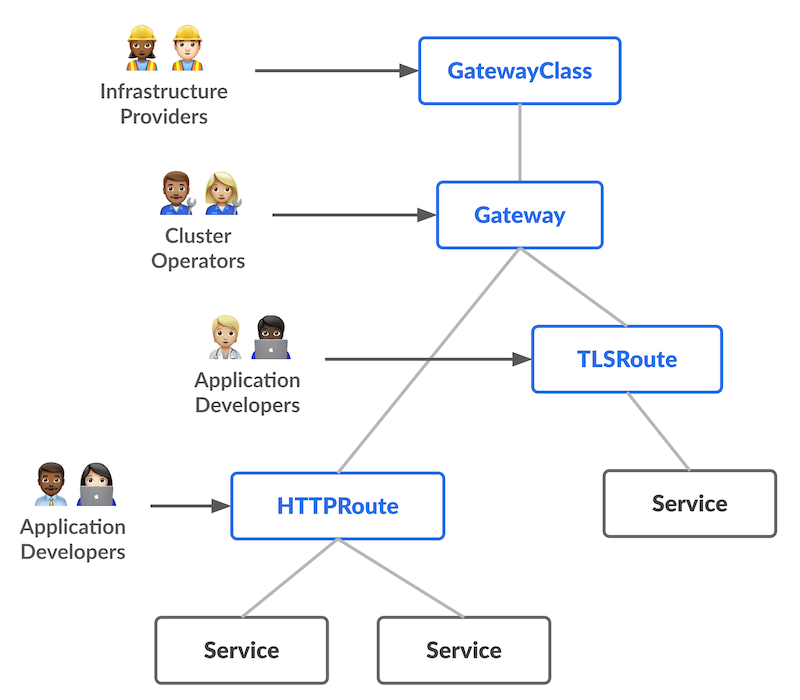
Gateway Class
- Defines a group of Gateways that share the same configuration and behavior.
- Each GatewayClass is managed by a single controller, though a controller may handle multiple GatewayClasses.
- Since GatewayClass is a cluster-wide resource, at least one must be defined for any Gateway to function.
- This is similar to IngressClass for Ingress and StorageClass for PersistentVolumes.
Gateway
- A Gateway defines how traffic is translated to Services within the cluster.
- In simple terms, it sets up a mechanism to take traffic from a source that doesn’t understand Kubernetes—like a cloud load balancer, an in-cluster proxy, or even external hardware—and direct it to a Kubernetes Service. Although many scenarios involve traffic coming from outside the cluster, that isn’t a strict requirement.
- The Gateway essentially requests a specific load balancer configuration that follows the rules and behavior defined by its GatewayClass. The gateway resource can be created either directly by an operator or automatically by a controller that manages the GatewayClass.
- Additionally, a Gateway can be linked to one or more Routes, which determine how specific portions of the traffic should be directed to particular services.
Route Resources
- Define the rules for routing incoming traffic from a Gateway to the appropriate Kubernetes Services.
- You can specify rules based on protocols (HTTP, HTTPS, TCP), URL paths, host names, and other attributes.
- Support functionalities like traffic splitting, retries, and header modifications, offering more control compared to the traditional Ingress resource.
References
- Kubernetes Gateway [Implementations].(https://gateway-api.sigs.k8s.io/implementations/)
This post is licensed under CC BY 4.0 by the author.